

Could there be more to your joint pain than worn cartilage?
If you have osteoarthritis, you may feel as though you already know why your joint hurts.
The cartilage has worn down. The joint is damaged. Perhaps an X-ray has confirmed it. You may even have been told that it is simply “wear and tear”, something that happens as joints get older.
It sounds logical: the more damaged the joint, the more it should hurt.
But osteoarthritis pain is not that simple.
One fact in particular changes the conversation: the cartilage itself does not have the nerve supply needed to directly produce the pain associated with osteoarthritis.
So if the cartilage itself isn’t hurting, where is the pain actually coming from?
The answer takes us beyond the old idea of a joint simply “wearing out”. Osteoarthritis affects the whole joint, and pain can be influenced by several different structures and processes, including bone, the tissues surrounding the joint, muscles and the nervous system.
For anyone living with osteoarthritis pain, understanding that distinction matters.
Because once we stop asking only “How damaged is my joint?”, we can start asking a potentially more useful question:
What is contributing to my pain?
Osteoarthritis pain does not come from worn cartilage alone. It can involve changes in bone, joint tissues, muscles and the nervous system. Understanding these contributing factors helps explain why osteoarthritis pain varies and why the condition of the joint does not always tell the whole story.
Osteoarthritis Is More Than Worn-Out Cartilage
Osteoarthritis, often shortened to OA, is the most common form of arthritis. It commonly affects the knees, hips, hands, feet and spine and can cause pain, stiffness, swelling and reduced movement.
For many years, medical professionals commonly explained osteoarthritis as a simple process of wear and tear: cartilage gradually wore away, the joint deteriorated and pain followed.
Today, we understand that osteoarthritis affects the whole joint.
Cartilage does change. It can become thinner and lose some of its ability to provide a smooth, resilient surface between the bones.
But changes can also occur in the bone beneath the cartilage, the joint lining and capsule, ligaments, tendons and surrounding muscles. The nervous system can also become increasingly sensitive when pain persists.
That gives us a much better starting point for understanding why an osteoarthritic joint may hurt.
Does Damaged Cartilage Actually Cause Osteoarthritis Pain?
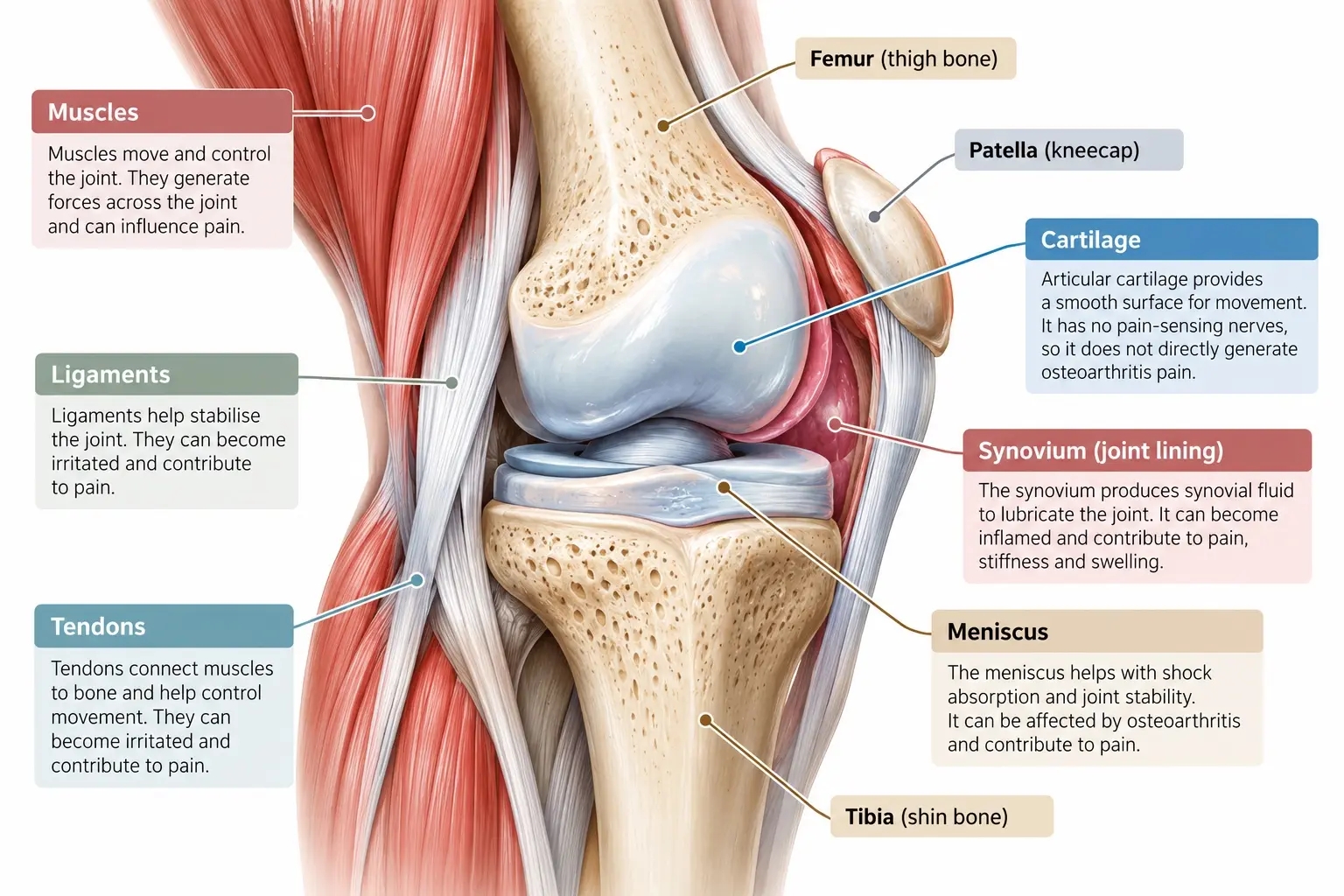
Damaged cartilage does not directly generate osteoarthritis pain because articular cartilage has no pain-sensing nerves. However, cartilage deterioration can contribute to changes in other joint structures, including bone, the joint lining and surrounding tissues, which do contain nerves and can become painful.
Articular cartilage is the smooth tissue covering the ends of bones within a joint. It helps the joint move smoothly and distributes forces across the joint surface.
As cartilage deteriorates, the way forces travel through the joint can change too. Other structures within and around the joint may become irritated, overloaded, inflamed or sensitive.
So rather than thinking:
“My cartilage is worn away, therefore my cartilage hurts,”
it is more accurate to recognise that osteoarthritis can create changes throughout the joint that contribute to pain.
And there isn’t necessarily one single source.
Why Does Osteoarthritis Hurt? Where Does the Pain Come From?
Osteoarthritis pain can arise from several structures and processes within and around the joint. These include changes in the bone beneath the cartilage, inflammation of the joint lining, irritation of surrounding tissues and increased sensitivity in the nervous system. Muscle function and joint loading can also influence symptoms.
Changes in the bone
The bone immediately beneath the cartilage, called subchondral bone, can change as osteoarthritis develops.
Unlike cartilage, bone contains nerves and can contribute to pain.
The joint lining and capsule
The joint is surrounded by a capsule, while its inner lining, the synovium, helps produce the fluid that lubricates the joint.
These tissues can become irritated or inflamed and may contribute to pain, stiffness and swelling.
Ligaments, tendons and surrounding tissues
A joint never works in isolation.
Ligaments help stabilise it. Tendons connect muscles to bone. Other soft tissues help guide and control movement.
Changes in the joint can alter how these structures are loaded and how they function.
The nervous system
Pain is not simply a direct measurement of physical damage.
When pain persists for a long time, the nerves and pain-processing pathways can become more sensitive. This can influence how strongly the body responds to movement, pressure and other signals coming from the joint.
And then there is another major part of the system that deserves attention:
The muscles that move and control the joint.
What Role Can Muscles Play in Osteoarthritis Pain?
Muscles influence osteoarthritis pain by controlling movement, supporting joints and generating forces across them. Muscle weakness and altered function can affect joint loading. Excessive muscle tension may also influence movement and loading, although its contribution to osteoarthritis pain varies between individuals and requires further research.
Osteoarthritis treatment often focuses on muscle weakness.
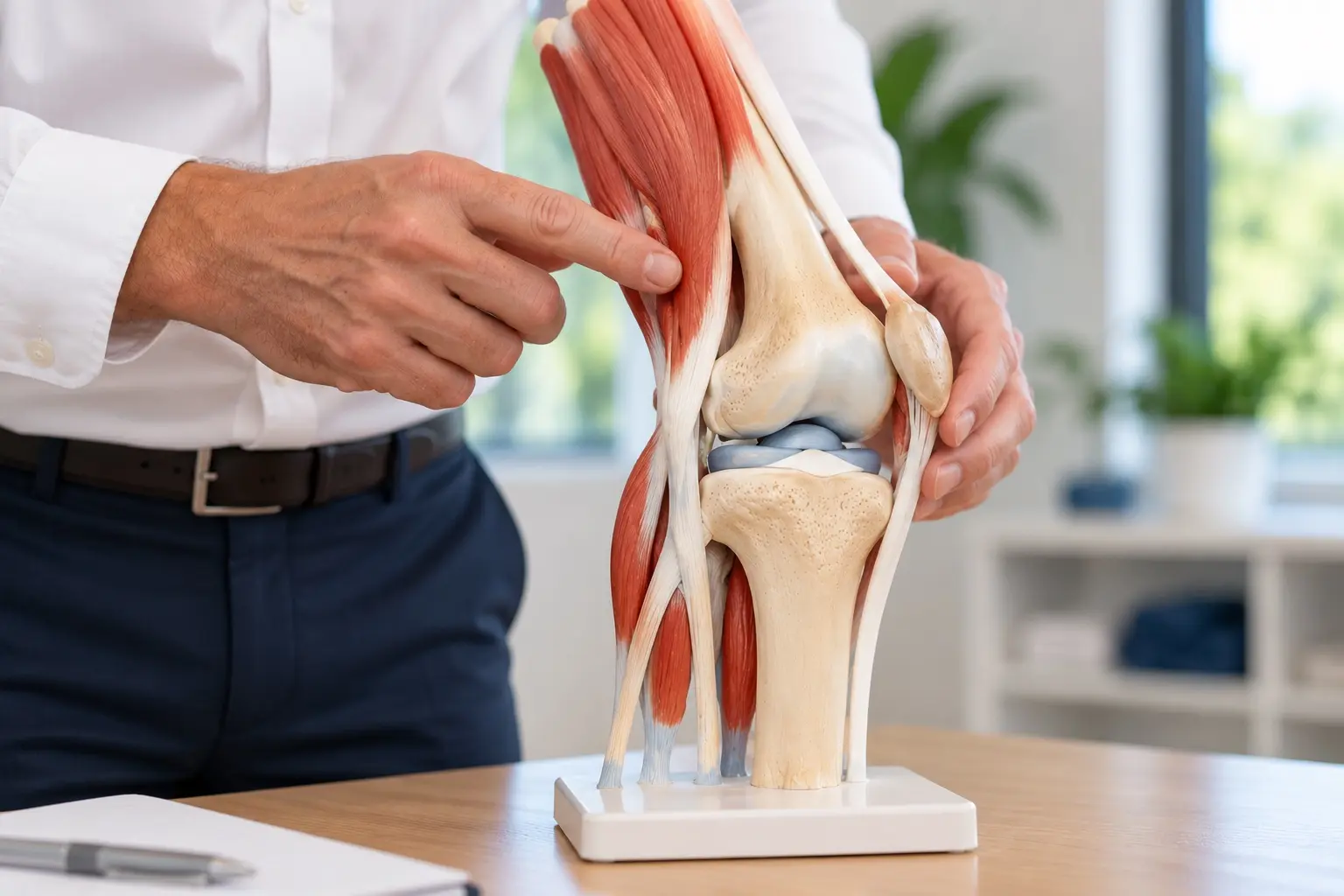
And for good reason. Strong, well-functioning muscles help us move, maintain balance and support our joints. Appropriate exercise and strengthening are important parts of conventional osteoarthritis management.
But strength is only one aspect of muscle function.
Muscles also create and control the forces acting across a joint.
Every time a muscle contracts, it pulls on a bone. Several muscles may be working together, or opposing each other, to move and stabilise a joint.
Ideally, those muscles work in balance.
But what happens when particular muscles become excessively tight or shortened?
They may influence how freely the joint moves and alter the forces acting across it.
In an already sensitive or osteoarthritic joint, I believe this is an important factor to consider.
And for me, it became a very personal question.
The Question That Changed the Way I Understood My Own Arthritis
I was diagnosed with osteoarthritis when I was just 17 years old.
For years, I lived with pain while trying to understand what was happening in my body. That search for answers was one of the reasons I eventually trained as a physiotherapist.
I exercised.
I strengthened.
I stretched.
I received physiotherapy treatment.
Eventually, I underwent surgery.
Yet I was still looking for an answer.
The turning point came when I stopped looking only at the arthritis itself and began looking much more closely at the muscles acting on my painful joint.
I discovered that working with the right muscle could change my pain and movement in a way that the approaches I had previously tried had not.
And that raised an obvious question:
If the structural arthritis in my joint hadn’t suddenly disappeared, what had changed?
My attention increasingly turned towards muscular tension and the effect it could have on the way forces were acting through the joint.
That distinction eventually became fundamental to the way I approached my own osteoarthritis and later to the way I worked with other people in pain.
Strengthening and Stretching Are Not Quite the Same as Understanding the Muscles
This is an important distinction.
I am not suggesting that exercise or strengthening is wrong. There is strong evidence supporting appropriate physical activity and exercise for people with osteoarthritis.
Nor is the answer simply:
“Stretch more.”
I had stretched before.
What became important was identifying which muscles were excessively tight, how they were affecting the movement of the joint, and what happened when those specific muscles were addressed.
A muscle can be strong and still be tight.
And stretching every muscle indiscriminately is very different from understanding the particular muscular pattern affecting an individual joint.
The approach I subsequently developed focuses on identifying those patterns and reducing unnecessary muscular tension so that the muscles around the joint can work together more harmoniously.
In my experience, this can be an important part of improving movement and potentially reducing excessive loading of a painful joint.
It is not an argument that muscle tension is the only cause of osteoarthritis pain.
Osteoarthritis pain can involve multiple structures and processes, and every person is different.
But I do believe excessive muscular tension is one potentially modifiable part of the picture that is too easily overlooked.
Why Does Osteoarthritis Pain Come and Go?
Osteoarthritis pain can fluctuate because symptoms are influenced by more than structural joint damage. Changes in activity, joint loading, inflammation, sleep, fatigue and nervous system sensitivity can affect how much pain someone experiences. This helps explain why an arthritic joint may feel relatively comfortable one day and painful the next.
You can have a relatively good day and a terrible one.
A joint may feel stiff when you first get up but improve once you begin moving.
An activity that caused little trouble last week may aggravate your symptoms today.
Yet the structural osteoarthritis in your joint hasn’t disappeared on the good day and suddenly returned on the bad one.
Other things are changing.
Muscles behave differently depending on what we have been doing. The sensitivity of the nervous system itself can change.
This doesn’t mean osteoarthritis pain is psychological or “all in your head”.
The pain is real.
But it does demonstrate something important:
The amount of pain you feel at any particular moment is not determined by cartilage loss alone.
And that is potentially encouraging.
Because while we cannot simply reverse every structural change within an osteoarthritic joint, some of the factors contributing to how that joint feels may be changeable.
A Better Question to Ask About Osteoarthritis Pain
None of this means that the structural changes associated with osteoarthritis should be dismissed.
Osteoarthritis is a real joint condition.
For some people, medication plays an important role in managing symptoms. Exercise and appropriate physical activity are widely recommended. Medical assessment is important, and for some people with severe osteoarthritis, joint replacement surgery can significantly improve quality of life.
The point is not to replace those approaches with another one-size-fits-all answer.
It is to recognise the difference between two questions:
What structural changes are present in my joint?
and
What is contributing to the pain I am experiencing?
The answers may overlap.
But they are not necessarily identical.
For me, that distinction changed everything.
Your Arthritis Diagnosis Is Part of the Story But Not Necessarily the Whole Story
Being told you have osteoarthritis can feel very final.
There is something visible on the X-ray. There is a diagnosis. And it can be easy to conclude that the pain is simply the inevitable consequence of a joint that has worn out.
But a joint is not a worn mechanical part.
It is living tissue surrounded and controlled by muscles, ligaments, tendons and nerves. It responds to movement, load and inflammation. And the way the nervous system interprets signals from that joint can change over time.
That is why understanding osteoarthritis pain requires us to look beyond cartilage alone.
For me, the breakthrough came from looking more closely at the muscles and asking whether excessive tension was adding unnecessary force to an already compromised joint.
For somebody else, the combination of contributing factors may be different.
But the question is still worth asking:
What is contributing to my pain and which of those factors might be changeable?
That is a very different question from simply asking how much arthritis you have.
And sometimes, asking a different question is where progress begins.

Your Arthritis Diagnosis Doesn’t Have to Be the End of the Story.
Understanding what’s contributing to your pain could open the door to a different approach. Discover Eugene’s personal journey with osteoarthritis and the thinking behind his work at The Living Well Clinic.
Frequently Asked Questions About Osteoarthritis Pain
Can osteoarthritis cause pain even when I'm resting?
Yes. Osteoarthritis pain is often associated with movement and joint loading, but it can also occur at rest, particularly when symptoms are more severe or the joint is inflamed. Persistent pain may also involve increased sensitivity within the nervous system. New or worsening pain at rest should be assessed by a healthcare professional.
Can muscle tension contribute to osteoarthritis pain?
Muscles influence how joints move and how forces are distributed through them. Excessive muscle tension may affect joint mechanics and contribute to discomfort in some individuals. At The Living Well Clinic, Eugene considers muscle tension as one possible contributing factor, alongside the established causes of osteoarthritis pain.
Is osteoarthritis pain always progressive?
Not necessarily. Although structural changes associated with osteoarthritis can progress over time, pain does not always follow the same pattern. Symptoms can fluctuate, and many people experience improvements in pain and function through appropriate management, even when structural changes remain.